We may earn a referral commission from some links on this page. It doesn't change your price or our recommendations.
Types of bow thrusters: how each works, and which your hull allows
Before you argue about brands, settle what your hull will let you cut. The mounting method comes first, and it rules out whole families of thruster before a price is compared. This page shows how each type pushes the bow sideways, where it sits on the hull and which boats it suits. Every dotted term on the site opens its definition, and the glossary page lists them all.
Most of these types can go at the stern as well. Of the external models the site lists, 30 are made only for the stern, by ezDrive, Max Power, Sideshift, Sleipner Side-Power and Yacht Thruster. DockStar’s stern listing is not counted, because it is the same unit as its bow one on a different track. The bow and stern page covers a unit at each end.
The short answer
- Five ways to fit one, on six mountings. A A tube bored straight through the hull below the waterline, with a propeller in the middle of it. It is the conventional thruster. Fitting one is mostly a labor job rather than a hardware one. is bored straight through the hull. An external unit or rail-mounted unit clamps to the outside. A pod bolts to the outside below the waterline. A A thruster that lives inside the hull and drops down through a hatch when you press the button, then pulls back up. It leaves no permanent hole in the water flow. leg drops down only while it is in use. A water-jet pump feeds two smaller A fitting that passes through the hull below the waterline, sealed with a wide lip on each side. Cutting one means the boat comes out of the water. in place of one large tunnel.
- Only two skip the haul-out. Bracket and rail-mounted units need no Lifting the boat out of the water on a travel lift or a trailer so work can be done below the waterline. It is billed separately from the job itself.. Pod, tunnel, retractable and jet all put something below the waterline, so they do.
- A tunnel is the permanent choice. Once it is in, it is part of the boat's structure. It is also one of the most expensive routes.
- Retractable and jet are for hulls a tunnel cannot fit. A retractable suits shallow draft, a catamaran hull or no room forward for a tube, but it needs a bigger opening than a tunnel. A jet suits a hull with no room for a tunnel at all, and it is the least efficient type here.
- A trolling motor is a stand-in. On a light pontoon, houseboat or aluminum hull it can do a version of the job. It is not built or sold as a thruster.
What each type drills, how long the job takes and what it costs are on the pages linked from each section below.
Where each one sits
External Fastened to the outside of the hull
-
Bracket mount
Bolts to the hull near the waterline
Two ½″ and one ¼″ cable hole, all above the waterline
-
Rail-mounted, deck or transom
Slides onto a fixed track bolted to the hull
Fastener holes only, above the waterline
-
External pod
Bolted to the outside of the hull, below the waterline
Yacht Thruster: one 2″ (50 mm) hole plus two 18 mm bolt holes. ezDrive: one 1¼″ hole plus three ⅜″. Sleipner SX: one 32 mm hole plus two 10 mm
Internal Housed inside the hull
-
Tunnel
A tube glassed straight through the hull, below the waterline
A 6″–9″ hole through both sides of the hull
-
Retractable
Housed inside the hull, below the waterline
A bigger opening than a tunnel, not a smaller one
-
Jet
Pump mounted inside the hull, connected to two through-hull fittings
90 mm to 4 in bottom intake plus two nozzle holes of about 65 mm, cut with a 64 mm hole saw
Look at where the propeller ends up in each panel. That decides what gets cut and whether the boat comes out of the water.
Tunnel
A tunnel thruster is a propeller inside a tube. The tube is bored straight through the hull below the waterline and permanently glassed in.
Push the joystick and the propeller spins one way or the other. It drives water out one side of the tube and the bow walks the other way. Once it is installed, it is part of the boat's structure. That is what makes it appealing, and it is also a big commitment.
VETUS and Sleipner both set a minimum depth for the tunnel, and a minimum rounding where its mouth meets the hull. Both are rules in their installation manuals. Our Sleipner review, our VETUS review, our Quick review and our Lewmar review cover each brand's range, its own documents and its owners.
It runs in short bursts. A DC tunnel thruster gives you a docking maneuver, then needs a cool-down before it is ready again. Every maker’s run limit is on its own page. That suits how you use one: a few hard pushes of a few seconds each, while you also work the throttle and the wheel. Nobody docks for ten minutes.
It is the most permanent route to a bow thruster and one of the most expensive. What it costs to fit is on the cost page, and how long the job takes is on the installation page.
Above the biggest electric units, or on a boat that already carries hydraulics, the same tunnel takes a hydraulic motor. The hydraulic page says who needs the pump.
On/off or proportional
Most DC tunnel units are on/off. The joystick closes a A heavy-duty electrical switch that carries the full motor current, closed by a small signal from the control panel. It is the part between the joystick and the motor, and it can corrode or stick. Contactor, relay and solenoid are three names for this one part., and the motor runs flat out at whatever voltage the battery gives it.
A A thruster with a controller between the battery and the motor, so the joystick sets how hard it pushes rather than just on or off. The motor and the mounting are the same. Only the control differs. puts a controller between the battery and the motor. The joystick then sets how hard it pushes.
Everything else is the same: same tube, same motor, same install. VETUS sells both, as its standard and BOW PRO ranges. Sleipner sells both as SE and SEP. The retractables come both ways too.
The difference shows at the battery. A weak supply costs an on/off unit thrust, and it costs a proportional one run time. The battery page has the makers’ own figures for both, and the proportional page prices the controller model by model.
External mount: bracket, rail-mounted and pod
All three are versions of one idea. A self-contained propeller unit fastens to the outside of the hull, so nothing goes through the middle of it.
- Bracket. The unit clamps to the bow, with the propeller hanging alongside. It is in the water, but it never goes inside the hull.
- Rail-mounted. The unit rides a track fixed to a The flat surface across the very back of the boat., rail or bracket, and stays on it. You lower it to dock and lift it clear of the water when you are underway.
- Pod. The unit bolts flush to the outside of the hull skin, below the waterline. Only its mounting bolts and a cable passage go through anything.
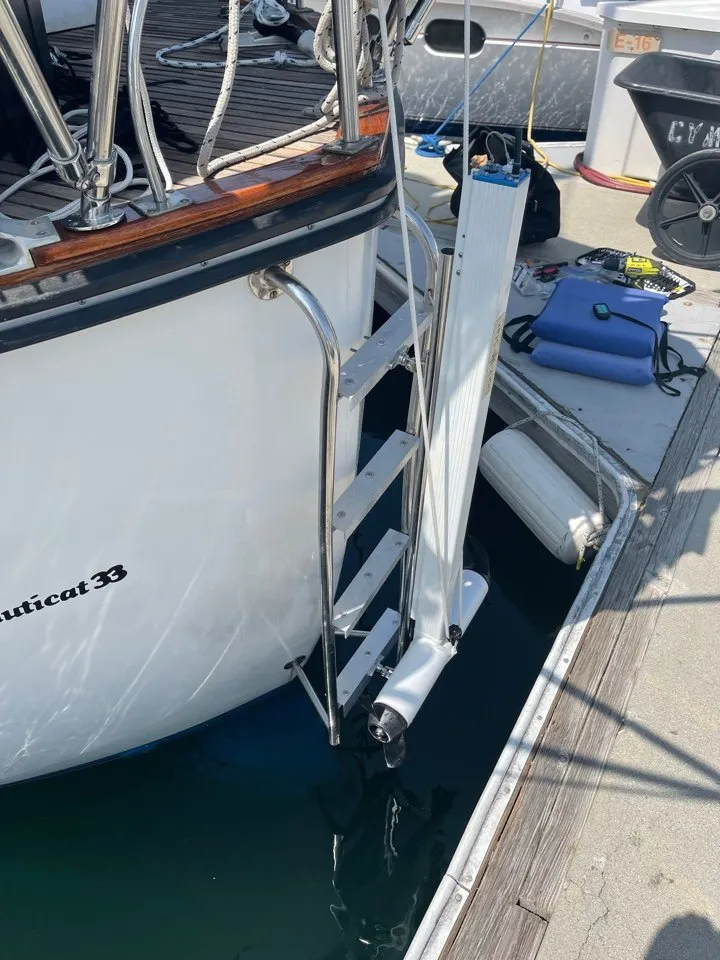
Published installation sheets for this style of mount show the same pattern at either end of the boat. One mount sits about a foot above the waterline and the other about three feet above it. The propeller ends up around a foot below the waterline.
On a transom that stands nearly straight up, the propeller ends up deeper, because there is no slope to carry the leg out from the hull.
The bracket and rail-mounted versions need no Lifting the boat out of the water on a travel lift or a trailer so work can be done below the waterline. It is billed separately from the job itself.. The pod does, with far less cutting than a A tube bored straight through the hull below the waterline, with a propeller in the middle of it. It is the conventional thruster. Fitting one is mostly a labor job rather than a hardware one..
Sleipner describes its own external pod this way: “no Glass-reinforced plastic: what European makers call fiberglass. Most production hulls are built from it, so "GRP work" means cutting into the hull itself and glassing it back up. work, three small holes”.
That sums up the whole group's trade against a tunnel. You get a fraction of the cutting and the downtime, and in exchange the unit hangs off the hull where you will see it every time you step aboard. The head-to-head page works the trade point by point.
The battery-powered rail-mounted units run on a charge. You get a stretch of continuous use, then a longer wait to recharge. A charge is about 10 minutes of thrust, and a docking uses seconds of it. So one charge covers a day of ordinary dockings.
Retractable
Mechanically, a retractable is closest to a A tube bored straight through the hull below the waterline, with a propeller in the middle of it. It is the conventional thruster. Fitting one is mostly a labor job rather than a hardware one. thruster. One thing about the fitting is different. The whole unit, propeller included, drops down through an opening in the hull only while it is in use. Then it retracts flush.
Sleipner sells it as thrust from good depth, with no permanent tunnel running through the bow to get it.
The opening is bigger than a tunnel's. The housing has to pass all the way through the hull to deploy. So the hole it needs is larger than a fixed tunnel's bore. If you were hoping for a tunnel without the hole, this is a tunnel with a bigger one.
It suits boats a fixed tunnel cannot fit: shallow draft, a catamaran hull, or no room forward for a bored tube. The retractables page has the makers’ own opening sizes, the speed limits and the prices.
Water jet
A water jet uses a centrifugal pump below the waterline. The pump feeds hoses to nozzles at the bow, the stern, or both, and a valve picks the direction. It trades one large A tube bored straight through the hull below the waterline, with a propeller in the middle of it. It is the conventional thruster. Fitting one is mostly a labor job rather than a hardware one. bore for two smaller A fitting that passes through the hull below the waterline, sealed with a wide lip on each side. Cutting one means the boat comes out of the water..
Jet Thruster's own documentation calls for a bottom intake and a pair of nozzle holes. A tunnel needs a single tube through both sides of the bow. That makes the jet useful on a hull with no room for one.
A jet still needs holes in the hull. It is also the least efficient mounting on this page, with more plumbing and more pump for the same job.
For most US buyers it is not a live option. The maker sells direct from the Netherlands in euros. It names a Florida distributor that quotes on request, so no US price is published. Our Jet Thruster review has the manual's figures, the holes and the owner reports.
A trolling motor, pressed into service
A trolling motor is left out of the diagram above and the table below. It is not built or sold as a docking thruster.
It is designed for steady, low thrust aimed fore and aft, for a day of fishing. You steer it by turning the whole unit. Docking asks for something else: a short, hard push sideways, right now, while you also work the throttle and the wheel.
On a light pontoon, houseboat or aluminum hull, a bow-mounted trolling motor can hold the boat against wind and current at the dock. You put it down and leave it running, where a thruster gets a quick press. Its own page works out which boats that suits, from owner reports.
How much of the job can you do yourself?
Every model on this site carries a DIY level, from 5 (all of it is yours) to 1 (none of it is), and a bar of the labor hours split between you, the yard and a marine electrician. Here is the spread in each style.
Tunnel
DIY level 1 to 2
Leaves you the most: 4 to 16 h yours
Leaves you the least: none of it
The yard cuts the hull and glasses in the tube. Your part is the wiring prep, where the maker allows it.
Every tunnel model’s levelRetractable
DIY level 1 to 2
Leaves you the most: 4 to 16 h yours
Leaves you the least: none of it
More yard work than a tunnel: a housing in the bottom and a mechanism that moves. Your part is the same wiring prep.
Every retractable model’s levelExternal
DIY level 3 to 5
Leaves you the most: 1 to 3 h yours
Leaves you the least: 4 to 16 h yours
The widest spread. Some are yours from start to finish; a pod bolted on below the waterline is split with the yard.
Every external model’s levelYou Yard Marine electrician. Bar widths are labor hours; a haul-out is a note, not a slice.
How we rate DIY
- Level 5: Owner install. No yard, no electrician.
- Level 4: You fit it, electrician connects. You mount and wire it; a marine electrician makes the final connections.
- Level 3: Split with the yard. The yard does the below-waterline part; you do the wiring.
- Level 2: Wiring prep only. The yard fits the unit and does the hull work; you do the wiring prep.
- Level 1: Yard job. A qualified professional does all of it.
The level is set by who has to do which step, so it does not move when an hour figure does. How to read the DIY level and bar, with a real model at each level and where every hour figure comes from, is on the DIY install page.
Side by side, at a glance
| Type | How it pushes | How long it runs | Best when |
|---|---|---|---|
| Tunnel | Propeller in a tube bored through the hull and glassed in | Short bursts, then a cool-down | You dock constantly and can commit to the haul-out |
| External: bracket, rail-mounted, pod | Self-contained propeller fastened outside the hull | Varies by model: seconds per burst on Sideshift, minutes on the pods, about 10 minutes per charge on the battery unit | A haul-out isn't worth it, or the unit needs to be out of the water underway |
| Retractable | Full tunnel unit that drops down only while in use | Like a tunnel, while deployed | Your hull is too shallow or too short for a fixed tunnel |
| Water jet | Pump below the waterline, hoses to bow and stern nozzles | Continuous, as long as the pump allows | There is no room for a tunnel at all, and you accept the efficiency cost |
Trolling motors are left off this table. The section above says why.
Want the types that fit your own boat? The thruster finder is our free tool that matches a thruster to your boat. Answer six to eight questions and it lists the types and brands that fit.