We may earn a referral commission from some links on this page. It doesn't change your price or our recommendations.
Bow thruster without cutting a hole: what each really drills
Yes, you can fit one, as long as the hole you want to avoid is the one below the waterline. That is a bigger “as long as” than the word external lets on, because most thrusters sold as external still drill through your hull underwater. This guide reads the installation manuals to show what each one really asks of your hull, what you give up, and which boats each suits.
The short answer
Only two kinds of thruster avoid a hole below the waterline. One is an external mount like Sideshift. The other is a rail-mounted unit like DockStar. Both still need small holes above the waterline for cables or fasteners.
Yacht Thruster, ezDrive, Sleipner's SX units and Jet Thruster all go through the hull underwater, and all need a Lifting the boat out of the water on a travel lift or a trailer so work can be done below the waterline. It is billed separately from the job itself.. What they skip is the A tube bored straight through the hull below the waterline, with a propeller in the middle of it. It is the conventional thruster. Fitting one is mostly a labor job rather than a hardware one. and its fiberglass work.
A professionally installed tunnel on a 35 ft boat runs $10,100–$14,200, and it means cutting through both sides of the bow.
Most external makers publish no thrust figure, so you cannot compare push for the money against a tunnel. They also hang a leg in the water where debris and crab and lobster pot lines are. A single small unit runs out of push in a stiff breeze.
Pontoons, houseboats, trawlers and displacement cruisers. On a fast planing boat that trailers, a tunnel is often the right answer despite the hole.
What each option drills
The table below is built from the manufacturers' own installation documents. Start with the clearest example of the gap between a brochure and a manual.
Sideshift's brochure and its manual say different things. The printed product brochure headlines "NO HOLES". The SS-series installation manual asks for something else. It tells you to "drill two ½" (13 mm) holes and one ¼" hole through the bow of the boat" for the cables. It also calls for threaded inserts for the clamp strap.
Their product pages say the accurate thing: no holes below the waterline. That is the claim worth having. The brochure cover makes a bigger one.
Where it goes through
- Above the waterline. Bracket mounts drill two ½″ and one ¼″ cable hole through the bow. Rail-mounted units use fasteners only. Neither needs a haul-out.
- Below the waterline. Tunnels, pods, jets and retractables all open the hull under the water. That means a haul-out, and a hole that has to stay watertight for the life of the boat.
How big the hole is, drawn to scale
- ¼″ Cable hole bracket mount
- ½″ Cable hole bracket mount
- 1¼″ Pod shaft hole ezDrive
- 2″ Pod through-hull Yacht Thruster
- 3–4″ Jet intake Jet Thruster
- 7.3″ (185 mm) Tunnel tube conventional bow thruster
| Option | Holes through the hull | Below waterline? | Haul-out | Install time | DIY level |
|---|---|---|---|---|---|
| Sideshift A thruster that bolts to the outside of the hull, up near the bow or on the back of the boat. Its propeller hangs in the water below it. Nothing is cut through the hull, so there is no tunnel. | Two ½" plus one ¼" cable holes through the bow, plus threaded inserts | No | Not required | Claimed 6 to 8 hours. Owners report a day to a day and a half. | DIY level 4 |
| Rail-mounted (DockStar) | Fastener holes only, into transom, rail or a bracket | No | Not required | Self-contained battery, no boat wiring | DIY level 5 |
| Yacht Thruster pod | One 50 mm hole through the hull for the through-hull fitting that carries the wiring, and two 18 mm holes for the stainless rods that bolt through | Yes | Required | Claimed 1 to 2 hours, excluding all wiring | DIY level 3 |
| ezDrive pod | One 1 1/4 in hole for the main shaft and three 3/8 in holes for the M8 bolts (a 1/4 in hole where the lag bolt is used) | Yes | Required | The maker’s guide estimates 8 hours | DIY level 4 |
| Sleipner SX35 and SX50, its stern units | Three through the transom: one of 32 mm (1.3 in) for the main tube and two of 10 mm (0.4 in) for the support bolts, no fiberglass work | Yes | Required | Not published | DIY level 3 |
| Jet Thruster | A 90 mm to 4 in bottom intake plus two nozzle holes of about 65 mm, cut with a 64 mm hole saw per the manual | Yes | Required | Not published | DIY level 1 |
| Conventional tunnel, for contrast | A tunnel-diameter hole through both sides of the bow, typically 6"–9" | Yes | Required | Yard: 32 to 70 billed hours by boat length, most of a week on the hard. DIY: no published hours; one owner account is on the sailboat page. | DIY level 1 to 2 |
| Retractable | Larger than a tunnel's | Yes | Required | Generally not a DIY job | DIY level 1 to 2 |
DIY levels
- Level 5: Owner install. No yard, no electrician.
- Level 4: You fit it, electrician connects. You mount and wire it; a marine electrician makes the final connections.
- Level 3: Split with the yard. The yard does the below-waterline part; you do the wiring.
- Level 2: Wiring prep only. The yard fits the unit and does the hull work; you do the wiring prep.
- Level 1: Yard job. A qualified professional does all of it.
You Yard Electrician. The bar is labor hours; a haul-out is a note.
How we rate DIYTwo things stand out in that table. The first is about A thruster that lives inside the hull and drops down through a hatch when you press the button, then pulls back up. It leaves no permanent hole in the water flow. thrusters. Forum threads suggest them a lot, and they need a bigger opening than a tunnel does. That is the opposite of what the person asking wants. The retractables page has the makers’ own opening sizes.
The second is about hydraulic units. "Hydraulic" describes the drive, so a hydraulic unit does not avoid a hole either.
External Fastened to the outside of the hull
-
Bracket mount
Bolts to the hull near the waterline
Two ½″ and one ¼″ cable hole, all above the waterline
-
Rail-mounted, deck or transom
Slides onto a fixed track bolted to the hull
Fastener holes only, above the waterline
-
External pod
Bolted to the outside of the hull, below the waterline
Yacht Thruster: one 2″ (50 mm) hole plus two 18 mm bolt holes. ezDrive: one 1¼″ hole plus three ⅜″. Sleipner SX: one 32 mm hole plus two 10 mm
Internal Housed inside the hull
-
Tunnel
A tube glassed straight through the hull, below the waterline
A 6″–9″ hole through both sides of the hull
-
Retractable
Housed inside the hull, below the waterline
A bigger opening than a tunnel, not a smaller one
-
Jet
Pump mounted inside the hull, connected to two through-hull fittings
90 mm to 4 in bottom intake plus two nozzle holes of about 65 mm, cut with a 64 mm hole saw
Why trolling motors are not on that list
A trolling motor comes up in nearly every one of these threads. It is not a docking thruster, and nobody sells one as one.
A trolling motor is made to creep a fishing boat along and hold it there. It gives low thrust for a long time, pointed ahead or astern. You steer it by swinging the whole motor.
Docking asks for the opposite: a short, hard shove sideways the instant you ask for it, while your hands are on the throttle and the wheel. A bow-mount trolling motor has to be deployed, then aimed, then given several seconds to swing the bow. You do not have those seconds when a beam wind is setting you down onto the boat in the next slip.
That holds for the boats this page is mostly about. Some owners do report modern auto-deploy units working for docking. Those are light boats with a lot of The area of the boat the wind can push on: the hull sides, the cabin, the mast and rigging, or the canopy. A tall, boxy boat has a lot of it, and wind force does not care how slowly you are moving.: a pontoon, a A pontoon boat with three logs instead of two., a small aluminum boat.
We read twenty years of their threads for the trolling motor page. The verdict splits by boat weight, and our calculator and the forums do not agree about where.
The same idea, built for the job
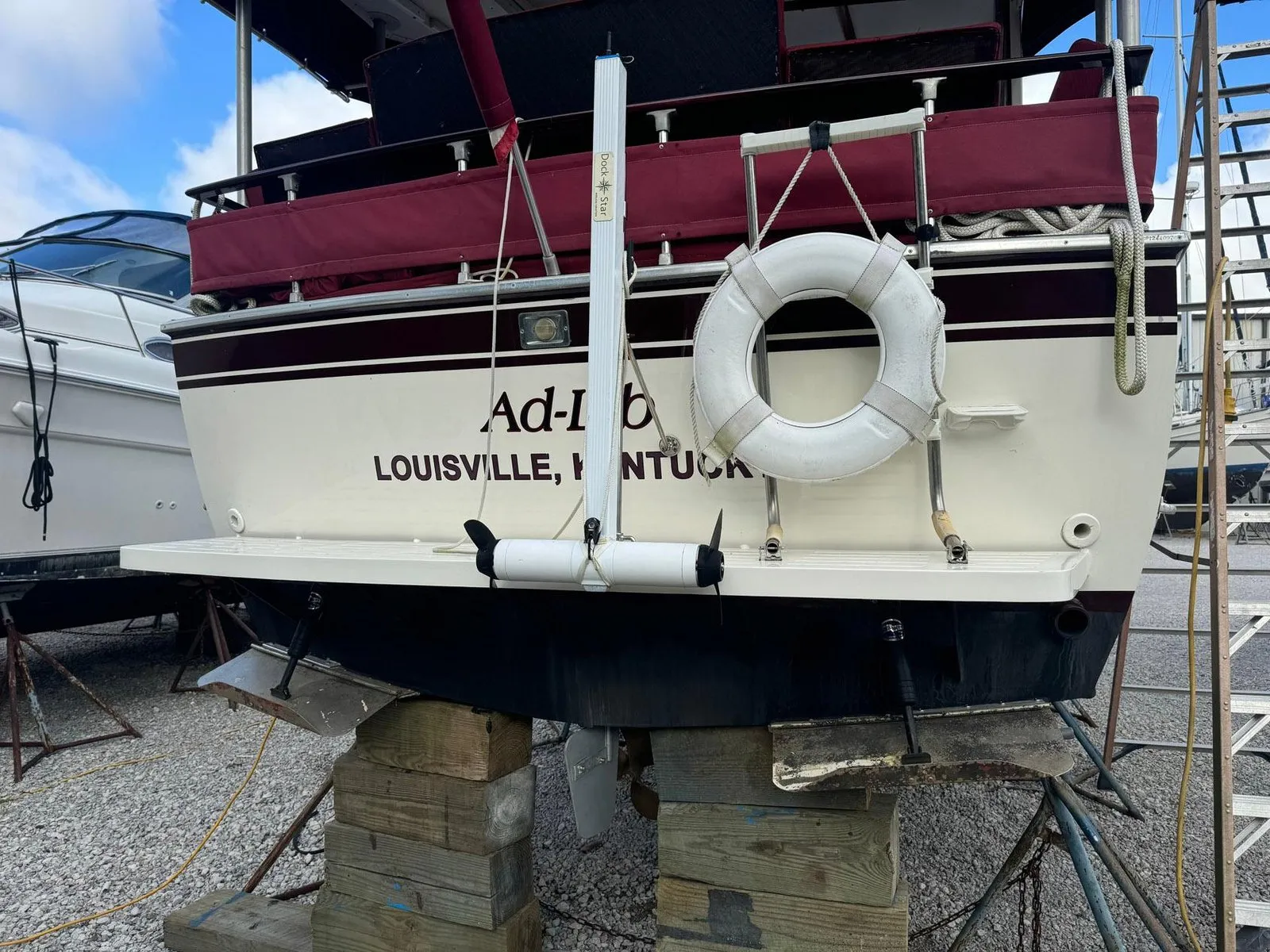
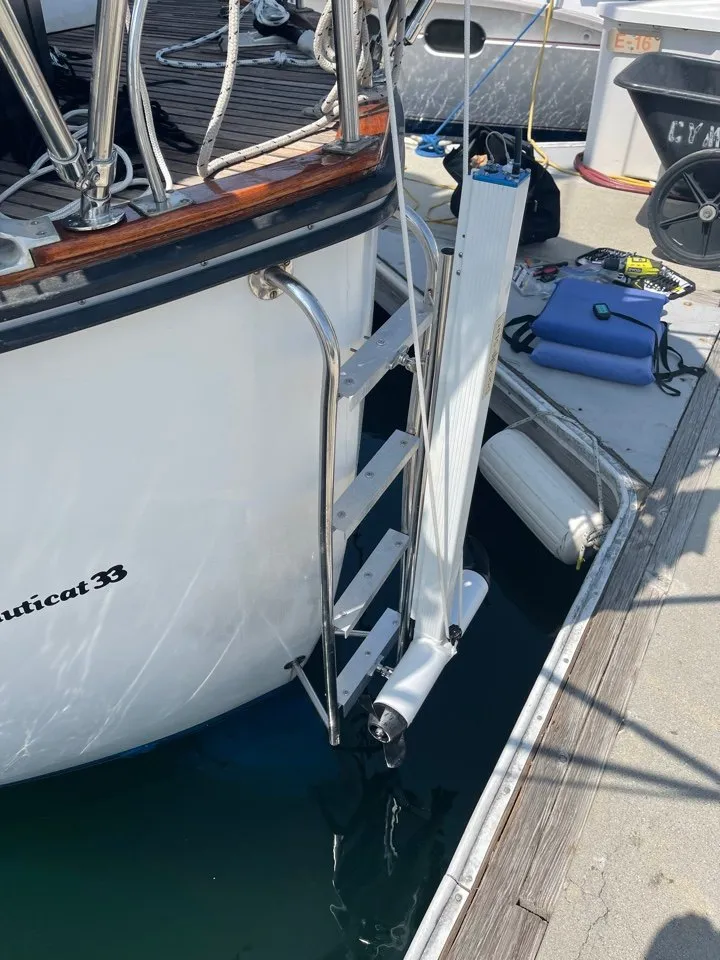
One product on this page is the trolling-motor idea built for docking. A DockStar rides on a track on your The flat surface across the very back of the boat. or bow and stays there. You lower it into the water to dock, and lift it clear on its track when you are underway. It runs from its own battery. Up to that point it sounds like a trolling motor.
What changes is the direction and the timing. It pushes sideways, in either direction, when you touch the control, with nothing to deploy or aim first.
The battery is inside the unit, so there is no bank to find room for and wire in. That is most of the reason the install is a couple of hours instead of a couple of days. There is no hole below the waterline and no Lifting the boat out of the water on a travel lift or a trailer so work can be done below the waterline. It is billed separately from the job itself..
You are not buying more push. Minn Kota publishes trolling motors rated at 115 lb of thrust. DockStar publishes 90 lb. Our calculator asks about 78 lb of a 40 ft trawler at the very bow to steer her in a 15 knot breeze.
Set both against that figure. The trolling motor steers her at about 18 knots, and the DockStar steers her at about 16 knots.
The owner further down this page who ran out of push in a breeze was not wrong either. The wind's push rises with the square of its speed, and no small unit keeps up with a strong one.
So what are you avoiding?
A tunnel install is a daunting job, and it is better to be daunted by the real one than by the forum version. Here is what it involves.
It starts with cutting a hole through both sides of your bow. The hole is usually oval rather than round, to allow for the angle of the hull's bottom. The tube is then glassed in, inside and out, with at least 8 layers by the makers' manuals. Finally it is faired, barrier coated and painted.
One documented DIY job on a 1985 Bayfield hit an inch of solid laminate. The owners fitted a six inch tube with under an eighth of an inch of tolerance. A yard has tools for lining the two holes up, and the install page has each maker's method.
Owners reading tunnel install threads react the same way. One asked:
“Am I the only one coming out in a cold sweat reading this?”
Trawler Forum, September 2017, on a tunnel install thread
Another, years earlier on a different forum, said:
“man does it take some guts to cut a hole that big in a hull...I guess if you do it enought it becomes no big deal!”
The Hull Truth, January 2010
In one of these threads a poster called cutting a hull tunnel "Easy peasy." Another owner replied that the one person saying it was easy was a professional doing it for a living. Both are true. Which one applies to you depends on what you have done before.
Who should choose which
Pontoons and tritoons: external or nothing
This one comes down to shape. A pontoon has no monohull bow to bore through. It has two or three aluminum tubes and a deck. There is no bow cross section for a side-to-side A tube bored straight through the hull below the waterline, with a propeller in the middle of it. It is the conventional thruster. Fitting one is mostly a labor job rather than a hardware one., and a hole in a buoyancy tube is the last thing you want.
The market confirms it. The pontoon products that exist bolt to the deck or the rail and lift clear of the water. Sideshift's PT series is an external unit that retracts. DockStar sells its unit on a pontoon track. Owners who go the cheap route fabricate a bracket for a trolling motor between the logs.
That bracket is an improvisation, and a pontoon is where owners report it working. The boat is light, the The area of the boat the wind can push on: the hull sides, the cabin, the mast and rigging, or the canopy. A tall, boxy boat has a lot of it, and wind force does not care how slowly you are moving. is high, and the motor has auto-deploy and a wireless remote. Often there is nothing else to fit. The split verdict is set out here.
Watch the bow space, though. On many A pontoon boat with three logs instead of two. there is not enough of it for a conventional bow-mount unit.
Houseboats: external, for practical reasons
A tunnel means hauling a 60 to 70 foot houseboat. On an inland lake that is expensive, and sometimes awkward to arrange. Flat-bottomed, shallow-draft hulls also make it hard to get the tunnel deep enough below the waterline.
Sideshift sizes two units specifically for this market, the HB340 and HB350. Both are priced in the houseboat guide.
Trawlers and displacement cruisers: the best fit for external
This is where the happiest owner reports cluster. Slow speeds mean drag barely matters. One engine driving one propeller. It steers with a rudder, so it loses steering at low speed, and in reverse the propeller kicks the stern one way only. handling makes a thruster useful. And the space forward is usually full of tanks already.
One owner's advice for this class of boat was simple. If you can fit a suitably sized external stern thruster, fit that and forget the bow entirely.
Sailboats: it depends on the forefoot
A narrow bow often has no room for a tunnel at all, which leaves the outside of the hull. Sailors also worry most about snagging lines.
Tunnel drag is more modest than it is usually made out to be, when the tunnel is properly faired. One owner, 13 years into a tunnel with a faired eyebrow (the smoothed lip above the mouth), reported outpacing similar boats.
Another poster on the same thread put the penalty at roughly a tenth of a knot. That was an estimate, not a test (YBW Forum, July 2020, owners’ words). A widely repeated figure of half a knot is not attributed to any test we could find.
One argument applies only to sailors, and it is the strongest case for a removable unit on this page. Under sail, a rail-mounted unit is lifted clear of the water on its track, so nothing drags. There is no tunnel to fair and no appendage in the water while you sail.
Center consoles and fast express cruisers: the hard case
This is where a bow pod stops making sense. At planing speed a hard wave lands on a unit hanging off the bow, so this site lists none for a boat that planes.
Sleipner draws the same line. Its EX series is its bow pods, which this site does not list; the SX units in the table above are its stern thrusters. Its external thrusters page offers the EX as “a practical thruster solution for displacement and semi-planing boats up to 60 feet, independently of hull form, hull-material, propulsion and depth” (read 16 September 2026). Add the beaching and trailering problem. Then add the looks objection, which this group of owners raises more than any other.
For a fast planing boat that trailers, a tunnel is often the right answer despite the hole. A retractable is the other bow route, where the hull has the depth.
One 35 ft center console owner was quoted $14,200 in January 2021 and declined it. Five days later he paid $9,200 at a second yard. That is one boat. The cost page has the length bands.
The exception is a stern unit on an outboard boat. A The flat surface across the very back of the boat. or The shelf across the back of the boat at water level, for boarding and swimming. A stern thruster can hang underneath it. mount stays clear of the running surface.
What your hull is made of changes the answer
On steel or aluminum a tunnel is easier. The tube is welded in, and there is no fiberglass work at all. Both VETUS and Sleipner sell metal tunnels off the shelf. If you have a metal boat and a competent welder, the "don't cut a hole" objection loses much of its force.
The risk shifts to Metal eaten away because two different metals sit in seawater connected to each other, or because stray current leaks into the water. It is the damage an anode exists to absorb. Most warranties exclude it. instead. Corrosion matters more when you hang an aluminum pod on an aluminum hull with stainless fasteners, with a heavy cable carrying hundreds of amps into it. The aluminum and steel page has each maker’s isolation rule and the one welded bill.
Wood is the strongest case for staying out of the hull. One owner fitting an external pod to a wooden-keeled boat had to epoxy aluminum braces inside. They reinforced the hull around a single penetration. That was one hole, and no tunnel.
A deck or hull built as a sandwich: two skins of fiberglass with balsa or foam between them. Bolts through it must be sealed, or water gets into the core and rots it. and sandwich hulls are the hardest case for any penetration at all. Every hole needs the core dug back and the void filled solid before the fitting goes in.
How long it really takes
Plan on longer than the marketing says. The gap between the claims and what owners report is consistent, and it always runs the same way.
| Who said it | Time |
|---|---|
| Sideshift marketing | "less than a day, with no previous experience" |
| Sideshift installation page | 6 to 8 hours per thruster |
| Owner, bow unit, working with spouse | About a day and a half |
| Owner, stern unit, with help | One day |
| Owner, stern unit connected to existing Absorbed glass mat: a sealed lead-acid battery with the acid held in fiberglass matting. It gives off no gas in normal use and holds its voltage well under a heavy draw. That is why thruster makers name it. bank | One day |
| Owner, below-waterline pod including bottom paint | One weekend |
| Yacht Thruster marketing | 1 to 2 hours "for the thruster itself (without cable connections)" |
Look at the last row. The wiring is the long part of the job, and the part people get wrong.
Where people get stuck
People almost never get stuck at the bracket. They get stuck on the electrical side, and the failure is sneaky: a wiring problem looks like a thruster that is too weak.
- Cable gauge over distance. Sideshift prints the distance two ways. Its FAQ allows the batteries 30 feet from the motor controller on 1/0 AWG cable for the 230 series. For the 350 it allows 50 feet on 2/0 AWG. Its installation manual says the total cable run must not exceed 10 ft. Run past the cable's reach and you lose voltage, which you feel as missing thrust. The wiring page computes the drop at both distances.
- Batteries too small for the job. The manual's start currents run from 200 to 550 amps across the four series. A tired The batteries that run the boat’s lights, fridge and electronics, as distinct from the engine’s starting battery. They are built for a slow, steady draw. will not supply that. The 350 series wants two 12 volt batteries in series, for 24 volts. Owners consistently report about a thousand dollars for the battery side of the job.
- Not getting the prop deep enough. Sideshift specifies the propeller at least five inches below the shallowest waterline. On some bows that rule ends the project before it starts.
- Pairing and programming. One owner reported working through several versions of the instructions. His receiver later failed from water getting in.
- Running it too long. Sideshift's guidance is bursts of five to ten seconds, and a maximum of 30 with a ten second cooldown. It says outright that the units are not designed to hold you against a dock for long periods. That is true of every thruster, of any type.
What an external unit costs you
Here is the downside, collected from owners who fitted these units and then lived with them through a season or two.
Thrust per dollar
Owners say an external unit makes less thrust for the money than a A tube bored straight through the hull below the waterline, with a propeller in the middle of it. It is the conventional thruster. Fitting one is mostly a labor job rather than a hardware one. unit of similar price, and that larger boats sometimes need a pair.
That is hard to check on published numbers. Sideshift publishes horsepower and amperage, and no thrust rating in pounds anywhere we could find. So it cannot be compared like for like against a VETUS or a Sleipner on published numbers. Converting horsepower into thrust would be a guess.
DockStar does publish a thrust figure. According to DockStar's published specification table, retrieved August 2026, the unit uses two 42A 12V motors for a combined 84A draw. It is rated at 1,008 watts and 90 pounds of thrust.
It runs from a 12.8 volt 15Ah lithium iron phosphate pack. The stated run time is 10 minutes per full charge, and it recharges in 5 hours from a 110 volt outlet.
Those figures agree with each other, which is not a given for spec sheets in this category. At 12 volts, 84 amps is 1,008 watts, or 1.35 horsepower, which matches what they quote. The pack holds 192 watt-hours. So 10 minutes at full draw uses about 88 percent of the nameplate energy, a plausible figure.
Ninety pounds is small-boat territory, roughly the smallest tunnel units on the market. It is useful for rotating a light boat in calm conditions, and owners say so. On a heavy boat in a stiff crosswind it runs out of push, and owners say that too.
One owner summed up a single unit in wind:
“We like the dockstar on calmer days, but if you get in any sort of wind it will not be enough.”
Trawler Forum, May 2022
One at each end is a different proposition
That wind limit is real, and it is the ceiling on a single unit at one end of the boat. Below is what a second unit at the other end changes, and what it does not. A thruster at each end has a page of its own, with every route to it priced.
The same unit works at either end. Only the track it rides on changes. Buy two, put one on the bow and one on the The flat surface across the very back of the boat., and the remote that ships with every unit already runs both.
Their manual is specific about it. The top four buttons drive the bow thruster, the bottom four drive the stern, and neither affects the other. There is no upgraded remote and no second controller to buy.
DockStar says the pair does three things one unit cannot. It can turn the boat through 180 degrees in place. It can move her sideways, which they call parallel parking. And it can hold her firmly against the dock while you get lines on.
How long a pair can hold her. Holding her to the dock is limited by the wind and the current. A pair of battery-powered units can hold her there for a short time, long enough to get a line on a cleat. It is a way to buy that time, and it is no substitute for the lines.
Those are their claims, and we have not tested them. The geometry supports them. Push the bow one way and the stern the other, and the boat rotates about its middle. Push both the same way and it crabs. A single tunnel thruster at the bow can do neither.
| What you get | Cost | Ends of the boat covered |
|---|---|---|
| One unit, stern, standard hull track | $4,270 | One |
| Two units, bow and stern, standard tracks | $8,650 | Both |
| Professionally installed tunnel thruster | $10,100–$14,200 | One |
Read the middle row against the bottom one. A pair comes in under what one professionally installed tunnel thruster costs at one end of the boat.
The unit price is $3,950 each. Add $430 for a standard bow track and $320 for a standard stern hull track. Shipping and sales tax come on top, and they do not publish those.
What two units do not fix. Each one still publishes 90 lb. Two of them give more turning and no more thrust at either end. The owner above who ran out of push in a breeze would still run out of push in a breeze. What he would gain is the ability to rotate and crab in the conditions where it does work.
The turning figure below is our arithmetic from the 90 lb figure. It needs one assumption, the distance between the units, and that is stated. Two equal pushes in opposite directions at opposite ends of the boat make a Two equal pushes in opposite directions, one at each end of the boat. A couple spins the boat about her middle without shoving her sideways. The further apart the two pushes sit, the harder the boat spins, which is why moving a thruster further from the middle does more than making it stronger..
A couple's turning effect does not depend on where the boat happens to pivot. It is the thrust times the distance between the units. On a 40 ft boat with the units 39 ft apart, that is 3,510 Pound-feet, the unit of turning effort: one pound of push, one foot away from the point the boat turns about. It is how you compare a thruster at the bow against one at the stern, because pounds of thrust alone say nothing about where the push is applied..
Comparing it to a tunnel does bring an assumption back in, because the tunnel's figure moves with the pivot. The review works that through.
A full review of the Smart Thruster carries DockStar's published specs, their documentation and every owner report we could find. It rebuilds DockStar's own turning-moment comparison, with every distance stated.
The Sideshift review reads their manual and FAQ against each other. It has owner reports back to 2012 and the figure they do not publish. The review of Yacht Thruster and ezDrive covers the pod that is external and still needs a hole, the one warranty case on record, and the price neither publishes.
If your boat already has a tunnel bow thruster and what you lack is stern control, you do not need a second tunnel. A single unit on the transom at $4,270 gives you the end you are missing, and DockStar says so itself. Adding a stern tunnel to an existing installation is most of a second install bill.
Their track options are here. Which one fits depends on your transom and The shelf across the back of the boat at water level, for boarding and swimming. A stern thruster can hang underneath it.. They size it from photographs and measurements.
It hangs in the water where things are
An owner on The Hull Truth put the worry this way:
“also no bow on the beach--and if you trailer???. If you rip a hole in the boat during an impact--the cost might be more than $3K.....”
The Hull Truth, June 2007
Debris strikes, dock contact, grounding, beaching and trailering are all real concerns, and owners raise them constantly. One owner in the Pacific Northwest had his yard build a fiberglass cradle to protect the unit from log strikes. That is fabrication work beyond what the kit includes. Another cruised the San Juans for years and never had a problem.
Sailors raise a more specific version. Anything sticking out underwater at the bow is something for crab and lobster pot lines to find at night.
Appearance
Looks come up in almost every thread. One owner put it bluntly:
“Other than being butt ugly the external bow thrusters seem to work well.”
Trawler Forum, May 2021
Another owner in the same conversation countered that you only ever see it when the boat is hauled. Both camps are well represented, and it comes down to taste, which no manual settles. The argument runs the other way too. One owner weighing a Sideshift said he preferred the look of the built-in unit and would rather cut the hole.
Growth, and what it can cost you
An external pod is one more thing to scrub, and Weed, slime and barnacles growing on anything that sits in the water. Inside a thruster tunnel it quietly costs thrust, and on a retractable it can stop the unit coming down. can jam it. Yacht Thruster's own FAQ tells you to antifoul it with an aluminum primer.
In one documented case, a Nordic Tug 37 owner's Yacht Thruster e-Thrust, a 12 V stern unit, failed within a few months of installation. Yacht Thruster declined the warranty claim. It blamed a barnacle growing in the tunnel and jamming the prop.
That owner was roughly $7,000 out of pocket between the replacement, shipping, haul-out and labor (Trawler Forum, November 2024). Two other owners of the same boat model in that thread reported good results. So this is one bad experience rather than a pattern, but the mechanism is worth knowing before you buy.
Reliability: a mixed record
Owner reports on external units run both ways. On the good side, one owner is eight years in on a 50 foot trawler with no issues. Another says his external stern unit gives him as much control over the stern as his factory tunnel bow thruster does over the bow.
On the other side, owners report a motor that failed inside two years and a water-damaged receiver. One had a shaft seal go at about seven years, with a replacement motor around a thousand dollars. The manufacturer was described as good to work with in that case.
Two things we cannot tell you, because the evidence does not exist. We found no data on how an external thruster affects US resale value, only opinions on looks running both ways. We also found no US insurance or survey requirement, exclusion or claim data relating to thruster type or install quality.
Anyone telling you confidently that an external unit hurts your resale, or that a survey will flag it, does not know that. What is documented is narrower. A fitting below the waterline that was bedded badly is a recurring way water gets in, and it takes a Lifting the boat out of the water on a travel lift or a trailer so work can be done below the waterline. It is billed separately from the job itself. to fix. The insurance page lists the documents we read and what each one says.
The argument against all of this
Here is the case against, as its supporters make it. The same 2007 poster who raised beaching and trailering wrote:
“If you must have a bow thruster, get a built in one, of adequate size. The side shift thruster is basically a large trolling motor. On the other hand, spend some more time working on boat handling...”
The Hull Truth, June 2007, the same post as the beaching and trailering caution above
The money version of that argument followed straight after in the same thread. If the external unit costs most of what a proper installed tunnel costs, buy the tunnel. Those 2007 prices are long gone. The question survives, and it is the right one to ask of any quote you get.
There is also the seamanship objection. It shows up less often in US forums than you might expect, and it is usually aimed at thrusters in general. The warning is that a thruster can become a first resort instead of a backup.
Skippers who reach for the button without reading the wind or planning the approach lose the habit of doing either. Then comes the day the equipment does not work. That is a fair warning. Learn The sideways kick a propeller gives when you put the boat in reverse. A single propeller pushes the stern one way and only that way. That is why a single-screw boat backs predictably in one direction and badly in the other., A dock line run forward or aft at an angle rather than straight across. Held against the engine, it pulls one end of the boat in to the dock. It is the cheapest docking aid there is. and the timing of your own boat's momentum first. Then treat the thruster as a help.
The answer from the other side is practical. One owner backs 300 yards out of his slip on a One engine driving one propeller. It steers with a rudder, so it loses steering at low speed, and in reverse the propeller kicks the stern one way only. diesel and calls the thruster a godsend. Another describes docking going from a stressful evolution to a confident one. Both are good reasons to buy a thruster.
What this means when you dock
If you already have a bow tunnel and the stern will not follow, you do not need a second tunnel. A single external unit on the transom gives you the end you are missing. The section “What an external unit costs you” prices it.
If you dock a heavy boat in a stiff crosswind, one small external unit will run out of push. Run your boat through the size calculator before you buy.
If you want to turn her in place or move her sideways, that takes a unit at each end. Push the bow one way and the stern the other and she rotates. A single tunnel at the bow can do neither.
If you find yourself holding the button down, you are asking too much of any thruster. Steer in short bursts. Sideshift's guidance is five to ten seconds at a time.
What we could not verify
- Sideshift publishes no thrust rating in pounds, so none appears here.
- Jet Thruster's US distributor is named on the maker's site with a Florida address and stock, but publishes no price. The two first-hand US owner reports we found are in the Jet Thruster review. No US invoice for an install is on record.
- AccuThrust, the integrated pontoon system, has manufacturer material only and no independent owner reports at all. It is also a factory build option rather than a retrofit.
- Galvanic corrosion on external pods is our inference from how marine corrosion is documented to work. We found no documented external-thruster case.
Product requirements taken from manufacturer installation manuals, guides and FAQs published by Sideshift, DockStar, Yacht Thruster, ezDrive, Sleipner and Jet Thruster. Owner accounts from dated posts on Trawler Forum, The Hull Truth, Sailboat Owners, Great Grady, Meridian Yacht Owners and Tugnuts.